We see it all the time: Canadian businesses (SMBs) that invest in research and development (R&D) are well-positioned to gain a competitive edge, develop cutting-edge solutions, and ultimately, achieve sustainable growth. When your organization’s activities often involve innovation projects, there are funding opportunities aplenty – including SR&ED tax credits.
Luckily, SR&ED is just one of many programs that are the product of the Canadian government’s recognition of the vital role that R&D plays in propelling our economy forward. That’s why they offer the Scientific Research and Experimental Development (SR&ED) program, a valuable incentive that rewards businesses for investing in innovation.
Now, what you’ve come here for: a full breakdown of SR&ED tax incentives.
Table of Contents
What are SR&ED tax credits?
In short, SR&ED credits are a tax incentive offered by the Canada Revenue Agency (CRA) to incentivize businesses to invest in scientific research and experimental development activities. These credits are not considered taxable income for your business, making them an even more enticing proposition.
By claiming SR&ED credits, you can significantly reduce your taxable income and boost your bottom line.
It’s important to note, though, that some provinces offer additional yet related funding programs alongside the federal SR&ED program. We recommend researching these opportunities to further enhance your R&D funding potential (or having Pocketed do the strategic planning instead). We’ll talk more about how to layer these opportunities later on in the blog.

How SR&ED Credits Work
SR&ED revolves around two key concepts: scientific research and experimental development. Scientific research involves a systematic investigation to establish new knowledge or facts about a scientific or technological phenomenon. Experimental development, on the other hand, involves using scientific knowledge to create new products, processes, or materials, or to improve existing ones.
There are two main ways SR&ED tax credits can benefit your business:
- Deductions from taxable income: Claim a portion of your eligible R&D expenditures as deductions from your taxable income, thereby reducing your overall tax bill.
- Tax credits based on a percentage of eligible R&D expenditures: Receive a tax credit based on a specific percentage (either 15% or 35%) of your qualified R&D spending.
SR&ED credits are calculated based on your eligible R&D expenditures. The exact percentage varies depending on the type of R&D activities you undertake. Typically, you can claim a deduction from your taxable income or a direct tax credit.
While the federal SR&ED program provides a solid foundation, several provinces also offer their own SR&ED programs with additional benefits or specific criteria. Be sure to research both federal and provincial programs to identify the most advantageous options for your business (or see if you can leverage both!).
SR&ED Eligibility
Of course, not all R&D activities qualify for SR&ED tax credits. The Canada Revenue Agency (CRA) outlines specific criteria to ensure projects are truly innovative and contribute to scientific or technological advancement.
To determine if your project qualifies for SR&ED tax credits, consider using the helpful SR&ED Eligibility Flowchart provided by the CRA: SR&ED Eligibility Flowchart. This interactive tool guides you through a series of questions to assess if your project meets the following criteria. Here’s a breakdown to help you:
- Technological uncertainty: Is there a level of uncertainty in your project’s outcome, meaning the result is not readily predictable based on existing knowledge?
- Scientific methodology: Is a systematic approach based on scientific principles being employed to conduct the research and development?
- Scientific or technological advancement: Does your project aim to achieve a scientific or technological advancement through the work undertaken?
- Intention to advance scientific knowledge: Is there a clear intention to contribute to scientific or technological knowledge through your project?
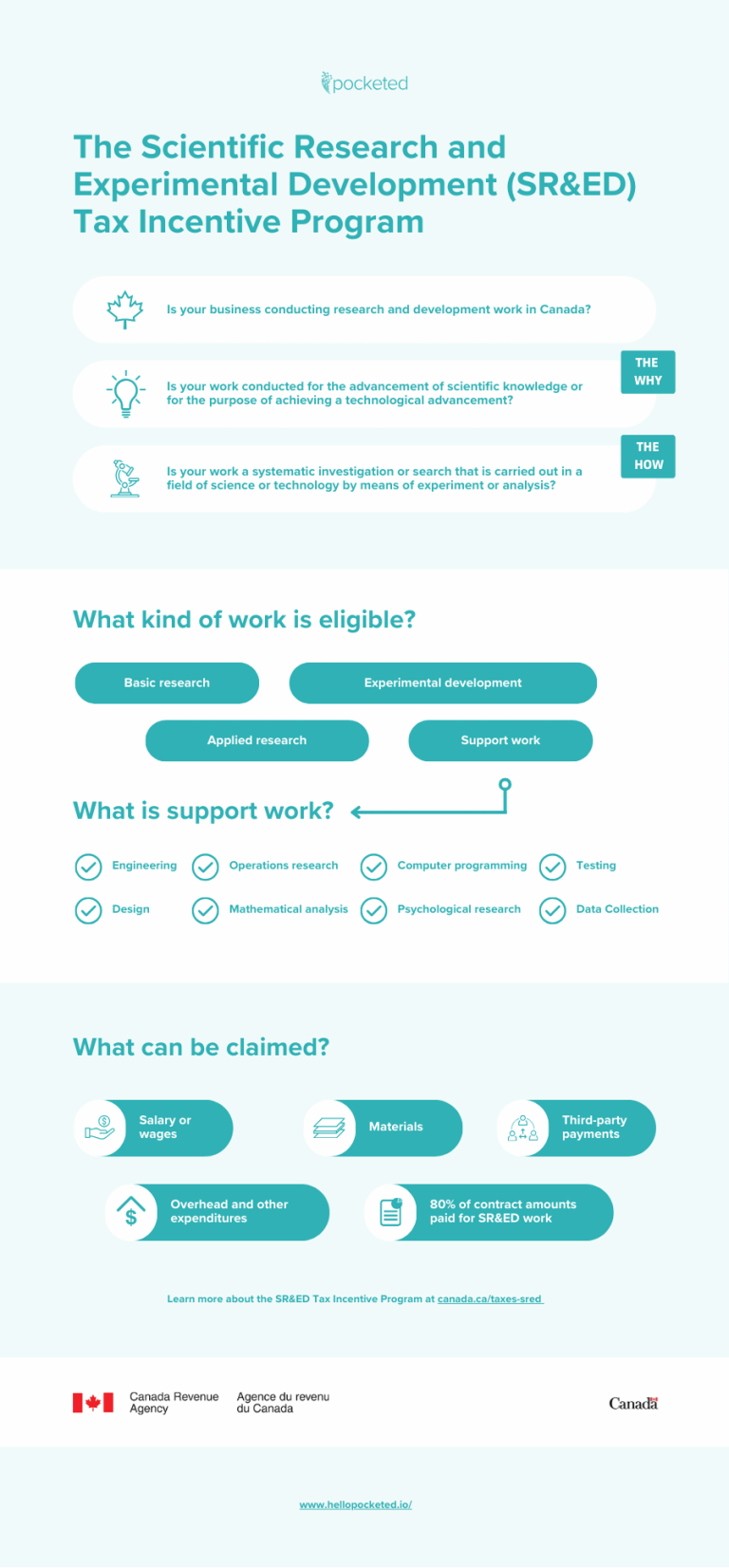
By understanding these key requirements and using the SR&ED Eligibility Flowchart, you can increase your chances of successfully claiming SR&ED tax credits and reaping the financial benefits of your R&D investments. Additionally, using a tool like Pocketed’s grant-matching tool can help you discover other funding programs that align with your SR&ED claim, maximizing the overall impact of your efforts.
Leveraging SR&ED Alongside Other Programs
As Pocketed CEO Brianna Blaney states, “Developing new technologies, particularly in high-priority sectors like AI, biotechnology, and clean tech, is highly fundable. This isn’t just through the SR&ED tax credit… there are various grant programs that will subsidize other elements of activities as well. One of our areas where we are really successful is helping clients identify how they can maximize the combination of these programs.”
In our innovation-focused webinar, titled Pocketed Presents: Unlocking Innovation Capital, we illuminate various funding options available to equip you with the knowledge to secure the perfect fit for your R&D project.

The Power of Program Stacking
One of the most effective strategies for maximizing your funding potential is to stack multiple programs. For example, you might be eligible to receive SR&ED tax credits combined with Mitacs funding. This means strategically combining SR&ED with other relevant grants to cover a wider range of expenses and achieve greater impact.
Key Benefits of Program Stacking:
- Enhanced Funding: By leveraging multiple programs, you can significantly increase the total funding you receive. Using a platform like Pocketed’s grant-matching tool can help identify additional programs that complement your SR&ED eligibility, allowing you to maximize your funding potential.
- Comprehensive Coverage: Combining SR&ED with other grants helps you cover a wider range of expenses, from R&D to marketing and commercialization. By exploring multiple funding options, you can ensure that more of your business activities are supported, and working with a grant specialist can make it easier to identify these opportunities.
- Synergistic Impact: Combining different funding sources can create a more powerful impact and accelerate your business growth.
Common Program Combinations
- SR&ED and Technology Adoption Programs: Combine SR&ED with programs that support the adoption of new technologies or digital solutions. Pocketed’s platform can identify technology programs that complement your SR&ED funding.
- SR&ED and Innovation Grants: Stack SR&ED with grants specifically designed to fund innovative projects in your industry.
- SR&ED and Export Development Programs: Leverage SR&ED alongside programs that support international expansion and market entry.
If you are claiming SR&ED, you are absolutely, without question, eligible for other programs.
Full. Stop.
- Brianna Blaney, CEO and Co-founder of Pocketed
Our team at Pocketed specializes in helping businesses identify and stack the most suitable funding programs. We’ll analyze your specific needs and recommend the optimal combination of grants to maximize your funding potential.
Read more The Ultimate Guide to Funding Your Innovation Projects
Discover More: Build Your Research Team: Everything You Need to Know About Mitacs Grants click here!
Calculating Your SR&ED Tax Credit
It probably goes without saying, but accurately calculating your SR&ED tax credit is crucial to maximizing its benefits.
The process involves several key steps:
- Identify Eligible Expenditures: Carefully review your financial records to identify all expenses directly related to your R&D activities. This includes salaries, wages, materials, contract services, and other relevant costs.
- Determine Eligible Project Time: Calculate the portion of your employees’ time that was dedicated to R&D activities.
- Apply the SR&ED Calculation Rates: The CRA provides specific calculation rates for different types of R&D activities. Apply the appropriate rate to your eligible expenses.
- Factor in Provincial Programs: Some provinces offer additional SR&ED credits or programs. Research and include these benefits in your calculations.
- Consider Deductions and Carry-forwards: Understand the rules for deducting SR&ED expenses from your taxable income and carrying forward any unused credits.
For more details to help you while you complete this step, check out the Government of Canada website which has a great resource to provide more clarity.
Filing Your SR&ED Claim
The SR&ED claim process involves several key steps:
- Gather Documentation: Collect all relevant financial records, technical reports, project descriptions, and employee time logs.
- Prepare the SR&ED Claim Report: This comprehensive document outlines your R&D activities, methodologies, and results. It should clearly demonstrate how your project meets the SR&ED criteria.
- Calculate Your Claim: Use the information gathered to calculate your eligible R&D expenditures and the corresponding tax credit or deduction.
- Submit Your Claim: File your SR&ED claim with the CRA within the designated deadline.
Key Components of a Strong SR&ED Claim Report
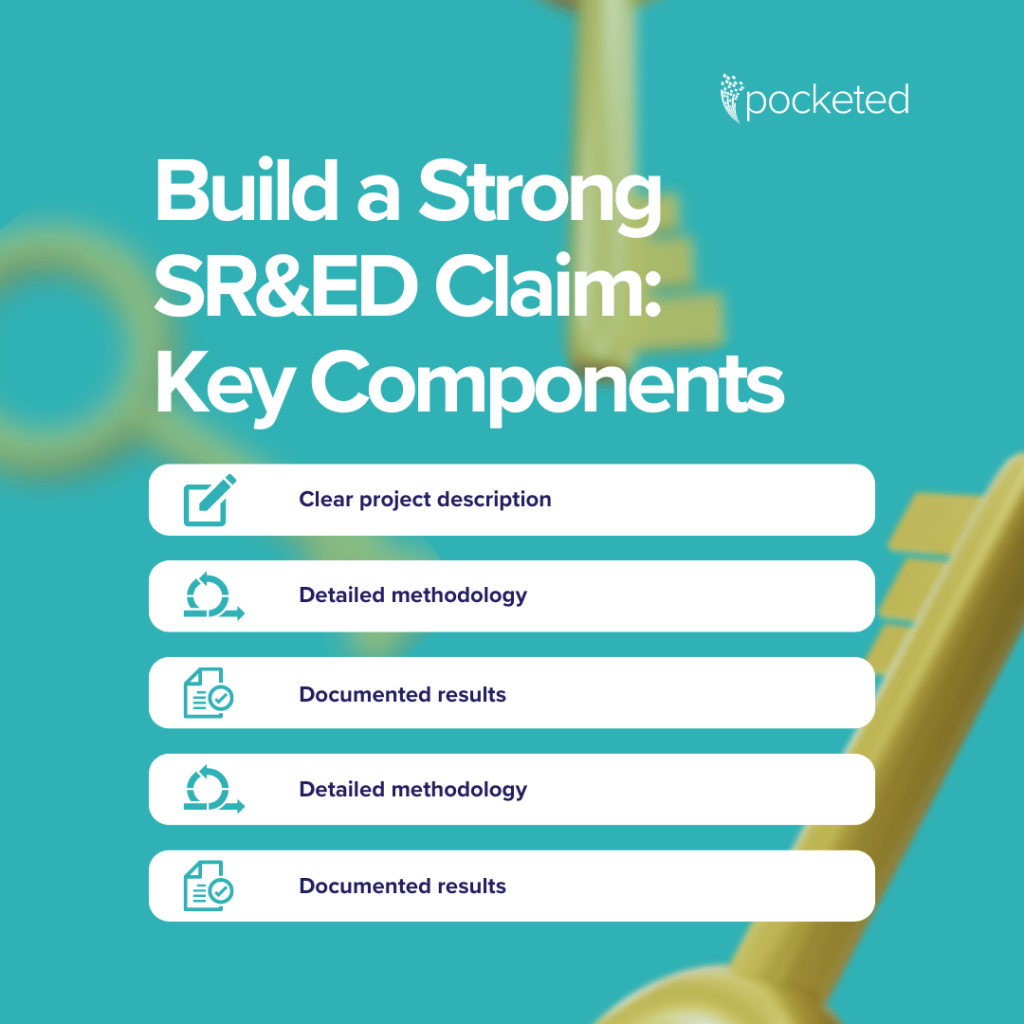
A well-prepared SR&ED claim report should include:
- Clear Project Description: Provide a detailed overview of your R&D project, including its objectives, scope, and expected outcomes.
- Methodology: Explain the scientific or technological approach used to conduct your research and development.
- Results and Outcomes: Document the findings, achievements, and any challenges encountered during the project.
- Innovation and Advancement: Demonstrate how your project contributes to scientific or technological knowledge and addresses a technological uncertainty.
- Eligible Expenditures: Clearly identify and justify all eligible expenses related to your R&D activities.
Maintaining Accurate Records for SR&ED Claims
Accurate recordkeeping is a cornerstone of a successful SR&ED claim. Detailed and comprehensive records mean you can provide the CRA with the evidence needed to substantiate your claim and maximize your tax benefits. Let’s talk about it.
Key Elements of Accurate Recordkeeping:
Project Documentation: Maintain detailed documentation outlining your R&D projects, including:
- Clear project objectives and goals
- Detailed descriptions of research methodologies and experimental procedures
- Evidence of technological uncertainty and the innovative nature of your project
Financial Records: Keep meticulous records of all expenses directly related to your R&D activities, such as:
- Salaries and wages of employees working on R&D projects
- Materials, supplies, and equipment used in R&D
- Contract services from external experts or consultants
- Travel expenses for R&D-related activities
Time Tracking: Accurately track the time spent by employees on R&D activities. This can be done through timesheets, project management software, or other appropriate methods.
Supporting Documentation: Gather supporting documentation to substantiate your claims, such as:
- Research papers, publications, or patents related to your R&D
- Correspondence with external collaborators or experts
- Invoices and receipts for eligible expenses
Best Practices for Recordkeeping:
- Consistency: Maintain consistent and organized records throughout the duration of your R&D project.
- Detail: Provide sufficient detail to clearly demonstrate the nature and scope of your R&D activities.
- Timeliness: Ensure that records are updated regularly and kept in a secure location.
- Electronic Storage: Consider using electronic recordkeeping systems to streamline organization and retrieval.
By following these guidelines and maintaining accurate records, you can significantly strengthen your SR&ED claim and increase your chances of a successful outcome.
Seeking Expert Guidance
While the SR&ED calculation process may seem straightforward, it can be complex and time-consuming. Consulting with an SR&ED professional can help ensure that your claim is accurate, complete, and maximizes your potential benefits.

Maximize Your Innovation Investment with SR&ED
By understanding the intricacies of SR&ED tax credits and strategically leveraging this government incentive, you can further drive your business’s growth and competitiveness. Don’t let the complexities of SR&ED deter you. With proper guidance and planning, you can unlock the full potential of this valuable program.
Key Takeaways:
- SR&ED tax credits offer a significant financial benefit to businesses investing in R&D.
- Understanding the eligibility criteria and maximizing your claim is essential.
- Consider stacking SR&ED with other government programs to increase your funding potential.
- Maintain accurate records and seek expert guidance throughout the SR&ED process.
Pocketed is here to assist you throughout the SR&ED process. Our team of experts can provide valuable insights, streamline the claim process, and help you maximize your SR&ED benefits.
With Pocketed’s support, you can unlock the full potential of SR&ED and drive your business forward!